
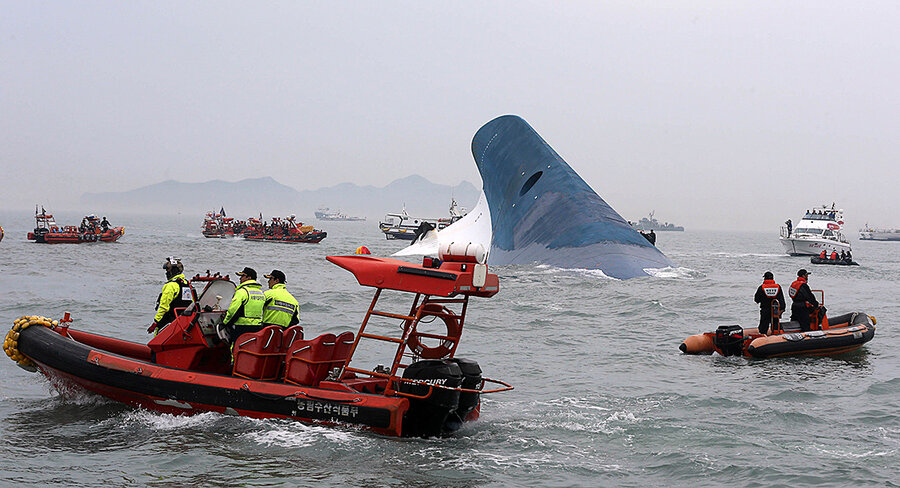
MV Sewol Ferry Sinking — April 16, 2014
On the morning of April 16, 2014, the MV Sewol, a 6,825‑ton ferry traveling from Incheon to Jeju Island, began to list sharply after taking an unreasonably sudden right‑J‑shaped turn in the Maenggol Channel. The turn caused cargo to shift, destabilizing the vessel. At about 8:50 a.m., the ship was leaning 30 degrees to port, lights went out, and the captain and crew ordered all passengers — including 250 students and 14 teachers from Danwon High School on a field trip — to remain in their cabins.
Timeline of the Disaster
- 8:30 a.m.: Sewol enters the Maenggol Channel.
- 8:40 a.m.: Sudden turn begins; cargo shifts.
- 8:50 a.m.: Severe list; captain rushes to bridge.
- 8:58 a.m.: First distress call received by control tower.
- 9:00–9:30 a.m.: Around 150–160 people jump overboard; engines stopped, ship drifts sideways.
- ~2.5 hours: Ferry sinks; 304 people die, 172 survive.
Casualties
- Total on board: 476 (339 Danwon School students, 325 students, 14 teachers, 339 general passengers, 33 crew).
- Fatalities: 304 (10 crew, 294 passengers, 261 Danwon students, 250 students, 11 teachers).
- Missing: 5 (presumed dead).
- Survivors: 172, many rescued by fishing boats before the Korea Coast Guard arrived.
Probable Causes
While no single cause was conclusively proven, investigations identified multiple contributing factors:
- Overloading: Carrying ~2,142.7 tons of cargo (over 3× the 987‑ton limit) and only 580 tons of ballast water (far below the 2,030‑ton recommendation).
- Unsecured cargo: Shifted during the sudden turn, worsening list.
- Steering error or malfunction: The sharp turn likely required a fatal steering error or mechanism failure.
- Human error: An unexperienced third mate was steering; no law requires the captain to be on the bridge when this occurs.
- Miscommunication: Distress call came from a passenger’s phone; crew made a later call.
Aftermath and Reforms
The disaster sparked widespread public outrage over safety lapses, regulatory failures, and poor rescue coordination. Three separate investigations found negligence by the captain, chief engineer, and 13 other crew members, leading to convictions for homicide, fleeing the ship, and negligence. The incident prompted major maritime safety reforms in South Korea, including stricter cargo loading rules, mandatory captain presence during steering, and improved emergency response protocols.
The Sewol sinking remains one of South Korea’s deadliest maritime disasters and a symbol of preventable loss of life, with memorials and advocacy groups continuing to push for justice and systemic change.